
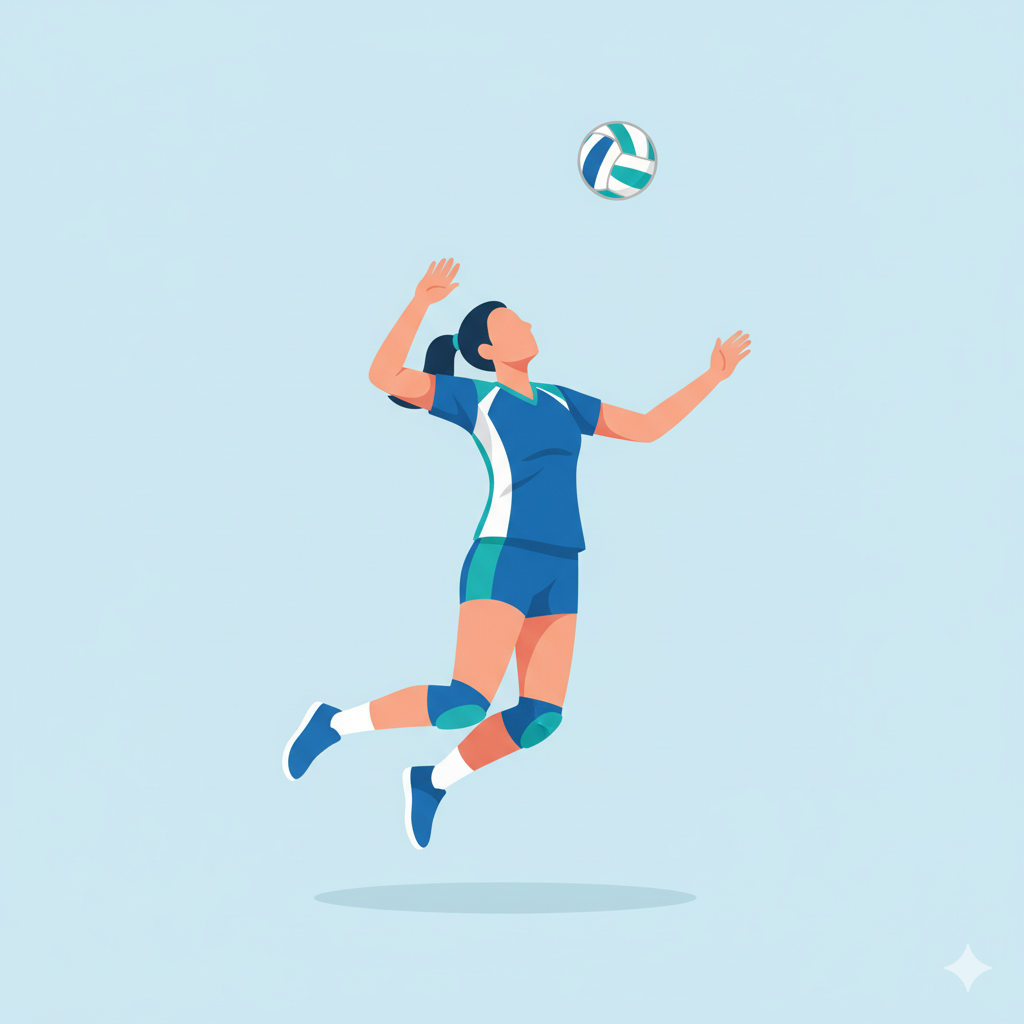
Why “Keep Your Eye on the Ball” is Terrible Advice for Hitters
It’s the first piece of advice every athlete learns, no matter the sport: “Keep your eye on the ball!”
In baseball, tennis, and golf, it’s gospel. So naturally, we yell it at our volleyball players too. When a hitter shanks a pass or hits the ball out, the immediate coaching reaction is usually, “You took your eye off the ball!”
But here is the crazy part: If your hitters are actually keeping their eyes on the ball the entire time, they are doing it wrong.
Recent eye-tracking studies on elite, Olympic-level attackers have completely dismantled this old-school advice. Top-tier hitters don’t track the ball the whole way. In fact, they intentionally ignore the ball for large portions of the play.
Here is why “keeping your eye on the ball” is holding your hitters back, and what they should be looking at instead.
The “Information Reduction” Strategy
When sports scientists strapped eye-tracking cameras to novice volleyball players, they saw exactly what you’d expect: frantic, chaotic eye movement. The novices stared at the ball as it left the passer’s arms, tracked it all the way up into the air, followed it down into the setter’s hands, and stared at it the entire way to their hitting window.
When they strapped those same cameras to elite professionals, they saw something completely different. The pros used a visual strategy called Information Reduction.
Instead of tracking the ball continuously, the elite hitters used fewer, longer visual fixations. They ignored the useless information and only looked at the high-value data points.
The Elite Player’s Visual Sequence
Here is exactly where an elite hitter’s eyes go during a play:
- The Pass: They look at the initial trajectory of the ball as it leaves the passer’s platform to judge the general direction and speed.
- The Saccade (The Eye Jump): While the ball is halfway through the air, the elite hitter’s eyes snap away from the ball. They execute a rapid eye movement (called a saccade) directly to the setter’s hands. They do not watch the ball travel through the air.
- The Central Pivot: As the setter releases the ball, the hitter doesn’t just stare at the ball. They establish a “visual pivot” in the central space between the setter and the net. Because locking their central vision onto a moving object gives them tunnel vision. By staring at a fixed, central point, they can use their peripheral vision to simultaneously track the ball’s flight path and the movement of the opposing blockers.
Why Peripheral Vision is the Secret Weapon
If the hitter isn’t staring directly at the ball during the set, how do they hit it? Peripheral vision.
By focusing their central vision slightly lower—often toward the opposing blocker’s chest or shoulders—the hitter uses their highly trained peripheral vision to track the ball’s arc.
This is the holy grail of attacking. If a hitter is staring a hole into the volleyball, they are flying blind against the defense. They have no idea if the block is early, late, closing the line, or leaving a massive seam. By shifting their central focus to the block, they can read the defense in the air and make late micro-adjustments to tool the block or hit the open sharp angle.
How to Train “Aerial Vision”
So stop yelling at your hitters to watch the ball. The game teaches the game, so start training them to gather information in game-like scenarios.
- The “Setter’s Hands” Drill: Toss balls to your setter. Have your hitters approach, but their only goal is to call out whether the setter released the ball from their forehead, chest, or chin. Force their eyes off the ball and onto the setter.
- Find the Blocker: Place two blockers in front of the hitter: one blocker positioned to take away the line attack, and the other to take away the cross-court angle. On each attack, only one of the blockers actually jumps. The other stays on the ground. The hitter must identify which blocker jumped while in the air and hit into the open space away from the block. If they are staring at the ball, they will hit right into the only person jumping.
The ball isn’t trying to stop your hitter. The block is. Train their eyes to look at the thing that actually matters.

Interesting perspective! I hadn’t realized that top-level players don’t track the ball constantly. It really makes me think about how much anticipation and reading visual cues matter in hitting, not just keeping your eye on the ball.